

Every hour you spend on manual admin is an hour you don't spend on your business.

You copy data from one system into another. You send invoices by hand. You chase leads because nothing reminds you to. Every Monday you put together a report that takes two hours and is out of date by Tuesday. None of this is your job, it just ended up on your plate. We map out what's stealing your time and build the fix.
Built for companies that can't afford a quiet failure.
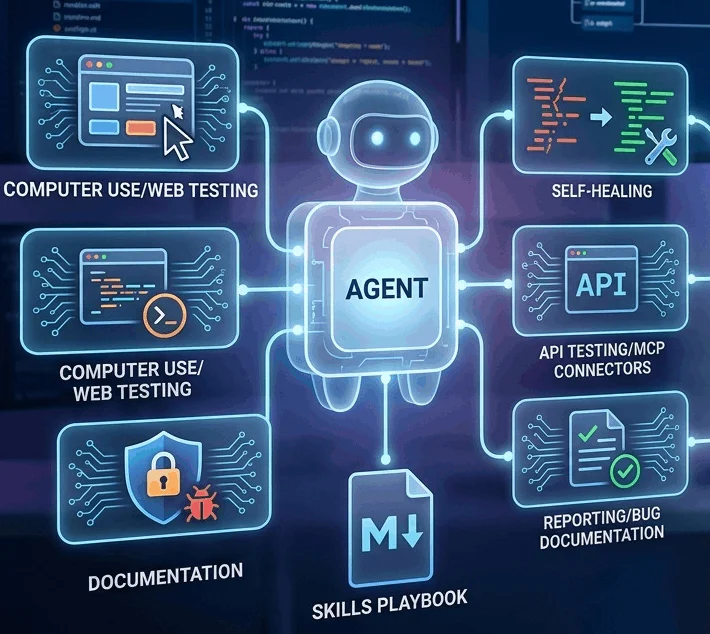
If a job happens on a computer, it can usually be automated — whole workflows, documents, email, data entry, the same small decision made a hundred times a day. If you've looked at that and worried about what happens when it goes wrong, this is for you. We work with companies who want it built properly: audit trails, fallback logic, GDPR compliance, and an engineer who stays accountable long after the invoice is paid.


Agentic AI workflows
Agents that reason and decide, not just move data from A to B. When one isn't confident, it escalates cleanly to a person instead of failing silently or flooding your inbox.
Automation that holds up outside the demo.
Document and data processing
The volume work: invoices, orders, compliance files, technical drawings. This is where the legal layer matters, so audit trails, retention policies and GDPR-compliant pipelines come as standard.
Search across your own knowledge
Drawings, specs and project history, searchable in plain language. It plugs into the tools your team already uses, so it feels like your existing software simply got smarter.
Agentic self-improvement
Where there is history to learn from, we replay years of your own cases through the system before it ever touches live traffic, then let it keep absorbing new edge cases. It gets more accurate the longer it runs.
Back-office and internal tooling
Approvals, hand-offs, status updates: the small internal tools that never make it onto the roadmap. Built around how your team already works instead of asking them to change.
We walk through how your business actually runs today. What a company thinks it needs is often a symptom of a different problem, so we dig until we find the real one and tell you straight what the right solution is.
- One call, no preparation needed
- Your process mapped end to end
- An honest answer on whether automation is worth it
You get a written scope: what gets built, why it is built that way, what it costs and how we will know it worked. No vague deliverables and no open-ended hourly work.
- Fixed scope and fixed price
- Every system and integration listed upfront
- Success metrics agreed before a line of code
We design the full solution and present it to your stakeholders or IT partner. Data flows, integrations and failure points are on the table before anything is built.
- Data flows and integrations mapped out
- Reviewed with your team or IT partner
- The last point to change direction at no cost
The core workflow gets built first and fast. You see it running on real cases within weeks, and your feedback shapes everything that comes after.
- Core workflow live in weeks, not months
- You test it on your own real cases
- Feedback steers the rest of the build
Everything around the happy path: what happens when an API is down, when data arrives malformed, when a human needs to step in. This is the part that decides whether an automation survives contact with reality.
- Edge cases and fallback logic covered
- Logging and monitoring built in from the start
- GDPR handled by design, not bolted on
Where historical data is available, we replay it through the system so it can be tuned and corrected before it ever touches live traffic.
- Validated against your historical data
- Accuracy tuned before going anywhere near production
- Documentation handed over to your team
A staged rollout instead of a big switch. We start with a slice of the volume, watch how it behaves, and scale up once the numbers back it.
- Staged rollout, nothing flipped overnight
- Monitoring and alerts active from day one
- A direct line to us during the first weeks
We stay involved after launch. The first three months of fixes are included, and from there a monthly retainer keeps the system monitored, scaled and improving as your volume grows.
- Three months of fixes included
- Proactive monitoring and scaling
- Ongoing improvements as your volume grows
Typical project duration is 4–12 weeks. We take on 2–3 clients at a time.


I'm Anton Broos
Founder, ActurniaI always wanted to work on business automation. I got there through web development, it was the easier entry point, and it taught me a lot about how businesses actually run. When AI took over most of that work, I made the full switch. Honestly, it felt overdue. What I do now is find the work that businesses have just learned to live with, the repetitive, error-prone stuff happening in the background, and make it stop being a problem.
Background
I hold a degree in electronics & computer science, with additional qualifications in electrical engineering. Before pivoting to automation, I spent two years in web development. I'm currently operating as a sole trader (zelfstandige), in the process of converting to a formal company structure.
I work with any tool or framework a project needs. The AI landscape moves fast — fast enough that learning to learn beats mastering any single tool that'll be outdated next year.
- Email [email protected]
- Phone +32 474 044 022
The thing I do differently
When a client comes to me with a request, I try to understand the problem underneath it. Businesses often come in asking for a specific solution, but that solution isn't always what they actually need. I dig deeper to find what's really going on, and more often than not, what we build together solves more than the problem they originally came in with. I've turned down work when the honest answer was that they didn't need what they were asking for.
Anton Broos
Founder, Acturnia
Tell us about your project.
Ready to find out what's worth automating?